About the study
The U-RESPOND study aims to improve the NHS Lung Cancer Screening programme. We want to understand what people think about lung screening, including newer methods like blood tests. Your feedback will help us make screening services better and more accessible for everyone.
Who is elgible?
We need to hear from people with a range of experiences. You are eligble and should have received an invite if:
- You have attended a Lung Health Check.
- You were invited to a Lung Health Check but chose not to attend.
Your unique viewpoint is essential for us to get a complete picture.
Why?
To improve future screening, researchers need to understand the views of people who did not take it up as well as those who did. The study asks what matters to people when considering screening, including views on CT scans and possible future approaches such as blood tests.
If you would like to read more information, please follow this link to the patient information sheet where you can also complete the questionnaire.
All NHS research is reviewed by an independent Research Ethics Committee to protect your interests. This study has been reviewed and given a favorable opinion.

Full Study Title: Engaging Adult Participants with Hyperlipidemia Considering Participation in Gene Editing Clinical Trials: A Study to Provide Familiarity with Trial Environments and Establish Baseline Clinical Data.
We are conducting a patient engagement study, which is a research study that does not include an investigational drug. This study aims to help participants with or at high risk for ASCVD and/or uncontrolled hyperlipidemia decide if they want to participate in and confirm if they are suitable for ongoing gene editing studies aimed to help lower lipids/cholesterol.
Who can take part?
We will check your eligibility for the patient engagement study using the following criteria:
- You must be a male or female aged between 18 to 70 years (inclusive).
- You must have a known or suspected history of one of the following:
- ASCVD and/or,
- Severe hypercholesterolemia (high levels of cholesterol in blood) and/or,
- Familial hypercholesterolemia (FH) (an inherited condition that causes very high cholesterol levels) and/or,
- Severe hypertriglyceridemia (very high levels of triglycerides, a type of fat, in the blood) and/or,
- Prior or documented history of elevated Lipoprotein(a) (high levels of a specific type of cholesterol particle in the blood that increases risk for heart disease)
- You must be currently taking a cholesterol-lowering medicine (e.g., statin, ezetimibe, or PCSK9 inhibitor) or have a documented history of side effects to at least one cholesterol-lowering medicine.
- You must have cholesterol levels that remain too high even after taking approved cholesterol lowering medications. You must be able and willing to provide informed consent to participate.
- You must be able and willing to comply with study assessments.
You will be asked to attend an in-person visit, during which we will give you a tour of the study unit and perform tests and assessments such as taking your blood, checking your heart and carrying out a physical examination. These tests can be spread over multiple days (if required).
The whole process takes approximately 2 weeks, but optional visits can take place for up to 12 months
Study participants will be reimbursed for any study-related travel expenses. For your efforts you will receive up to a maximum amount of £40 per visit. Taking part in completely voluntary and you must be registered any of our practices. If you think you’re eligible and interested in taking part, please email hcl.trials@nhs.net
A clinical research study to evaluate an investigational therapy for severe asthma is enrolling now.
This is a randomized, double-blind, placebo-controlled study to evaluate the investigational drug GB-0895 and see how well it works to reduce serious asthma attacks in adults and adolescents with severe asthma, when used along with other treatments.
What is the medicine in the Study?
GB-0895 is an investigational drug, a monoclonal antibody that targets thymic stromal lymphopoietin (TSLP), which helps drive airway inflammation in asthma. In this study, it is given by injection under the skin every six months and used as an add-on to participants’ usual asthma medicines; some participants will receive placebo. It is being studied in adults and adolescents with severe, uncontrolled asthma.
You may be eligible to join this study if you:
- Are 12 to 80 years old
- Have had an asthma diagnosis for more than
2 years - Have required corticosteroids at least twice
over the last 12 months to control your asthma
Those who qualify may receive:
- Reimbursement for selected expenses
- Free study-related care
- Free study medication
If you think you are eligible and interested in taking part, please email hcl.trials@nhs.net. Study participation is voluntary by contacting us, you do not have to take part in the study.


Clinical study for adults with Chronic Obstructive Pulmonary Disease (COPD)
The purpose of this study is to assess the safety and effectiveness of an investigational study drug, lunsekimig, in adults living with COPD. This study will compare the effects of the investigational study drug and placebo while you are still taking your usual COPD medications.
To be eligible for this study, you must:
- Be aged 40 to 80 years old
- Have had a diagnosis of COPD for at least 1 year
- Be a current or former smoker
- Have had at least 2 exacerbations of COPD in the last year or have been hospitalized in the last year for an exacerbation of COPD
- Be taking daily treatments for your COPD
An Ethics Committee (EC) protects the rights, safety, and well being of study participants. An EC has reviewed this study.
If you think you are eligible and interested in taking part, please email hcl.trials@nhs.net. Study participation is voluntary by contacting us, you do not have to take part in the study

Study Title: Blood Biomarkers for early and accurate diagnosis of Alzheimer’s Disease
in Primary Care (the BEAD-PC Study) – An Implementation Study of novel blood biomarker and digital technologies in diagnostic pathways in primary and specialist care towards an earlier and accurate diagnosis of Alzheimer’s disease
About the study
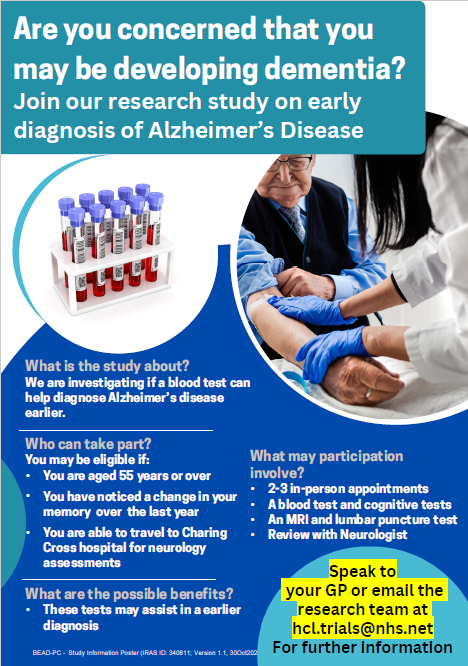
The BEAD-PC study focuses on whether a blood test for specific biological markers can be used to help diagnose Alzheimer’s disease in a GP setting. Diagnosing people at an early stage will allow for preventative measures of lifestyle interventions and access to medications which may become available and better access to supportive care in later disease stages.
The progression of the disease varies between individuals and the early stages may be characterised by only minimal changes in memory and thinking, which may remain stable, or progress to the later stages of dementia. These changes could remain undetected as the symptoms may be mistakenly regarded as normal age-related forgetfulness. However, dementia is not part of the normal ageing process. The aim of the BEAD-PC study is to assess whether a specific blood test in primary care can help diagnose Alzheimer’s disease at an early stage.
To enrol in this study, you must:
- Be aged 55 or over
- Have recent memory problems (noticed in the last one year)
- Be able to attend an appointment at a Cognitive Assessment Clinic and 1-2 subsequent visits to Imperial Memory Unit at Charing Cross hospital
- Be willing and able to undergo a lumbar puncture (spinal tap)
- Be able to provide consent
An Ethics Committee (EC) protects the rights, safety, and well being of study participants. An EC has reviewed this study.
If you think you are eligible and interested in taking part, please email hcl.trials@nhs.net. Study participation is voluntary by contacting us, you do not have to take part in the study.
What is Black Health Legacy?
Black Health Legacy is a long-term research study for Black, Black African and Black Caribbean people that aims to improve our understanding of health and disease. In the past, people from Black, Black African and Black Caribbean backgrounds have not been well represented in research studies, and this means that important discoveries and breakthrough treatments may not help them.
Black Health Legacy will research medical problems such as type 2 diabetes, high blood pressure and kidney disease which affect many Black, Black African and Black Caribbean people.
We are led by an experienced group of healthcare and research professionals who are passionate about improving health for all Black, Black African and Black Caribbean people in the UK. Our leadership team includes representatives from Black, Black African and Black Caribbean communities.
You are eligible to join if:
- You are aged 16 or above
- You live in England
- You identify as Black, Black African, Black Caribbean or Mixed
ethnic background that includes Black African or Black Caribbean.
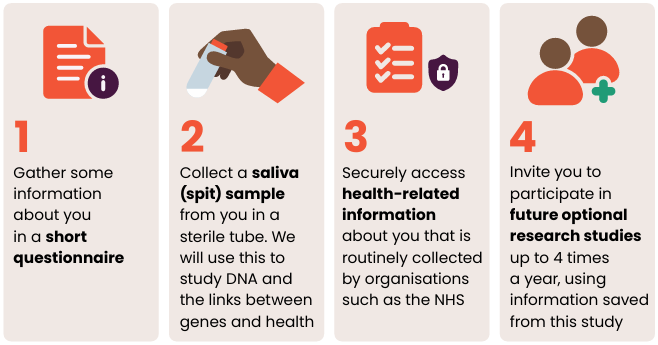
Joining is easy and takes around 10 minutes! If you agree to join Black Health Legacy, you will be asked to read and sign a consent form giving us permission to:
You can find more information on the study website: Black Health Legacy
Do I have to take part?
No, it is completely up to you to decide whether or not you wish to join the study. If you do join the study, you are also free to withdraw at any time and do not have to give a reason. You can take as long as you need to decide if you want to join the study and are welcome to discuss your participation with family and friends
If you think you are eligible and interested in taking part, please email hcl.trials@nhs.net. Study participation is voluntary, you do not have to take part in the study.

Obesity and weight management: Explore new possibilities for what you can do – powered by you, supported by us
Join a clinical study that aims to move research – and people – forward
The KaiNETIC-3 Study is looking at an investigational study drug to lower body weight and improve overall health for people living with obesity. Different doses of the study drug will be compared with an approved medication for overweight and obesity or a placebo.
Who can take part?
People who may be able to take part must:
- be 18 years or older
- be living with obesity
- not have diabetes
Other factors to consider
A group of doctors, nurses, and other medical staff (called the study team) will:
- Explain the possible risks and benefits of the study
- Monitor your health carefully
- Provide you with all study-related medication and tests at no cost. You will not be paid to participate in this study. You will be paid back (reimbursed) for reasonable expenses
An Ethics Committee (EC) protects the rights, safety, and well being of study participants. An EC has reviewed this study.
If you think you are eligible and interested in taking part, please email hcl.trials@nhs.net. Study participation is voluntary by contacting us, you do not have to take part in the study.
Full title: Surveillance of pAncreatic health aFter diabEtes Diagnosis
This is a randomised trial to evaluate the cfDNA Pancreatic Cancer test (Avantect) in the early detection of pancreatic cancer in patients with newly diagnosed diabetes mellitus.
Who is eligible to take part?
You are eligible if you have been diagnosed with type 2 diabetes in the past 6 months and aged between 50 to 84 yrs.
Pancreatic cancer is damages insulin producing cells similar to diabetes. So people diagnosed with diabetes have a higher chance who being diagnosed with pancreatic cancer. Currently there is no screening test for pancreatic cancer. This new Avantect test is designed to detect the possible presence of pancreatic cancer at an early treatable stage, long before symptoms become apparent.
If you are interested in more information, the study website goes deeper the what is involved in the study and if you think you are eligible, you can express your interest there.
Study Website: https://safe-d.uk/
Full Title: A Randomized, Double-blind, Parallel Group, Multi-center, Phase III Study to Assess the Efficacy of Budesonide, Glycopyrronium, and Formoterol Fumarate Metered Dose Inhaler Relative to Glycopyrronium and Formoterol Fumarate MDI on Cardiopulmonary Outcomes in Chronic Obstructive Pulmonary Disease (THARROS)
Aim: This study will evaluate the effect of triple ICS/LAMA/LABA therapy with BGF MDI 320/14.4/9.6 μg on cardiopulmonary outcomes relative to LAMA/LABA therapy with GFF MDI 14.4/9.6 μg in a population with COPD and elevated cardiopulmonary risk.
We are now recruiting participants for this study. If you think you are eligible or know someone who may be eligible, please email hcl.trials@nhs.net
| Could I be eligible to take part? | |
 You must You must |  You must not You must not |
| – Be aged between 40-80 years. – Have good inhaler-use technique. – Be diagnosed with COPD. – Be a current or former smoker. Have a cardiovascular risk. | – Have any other respiratory condition aside from COPD. – Have had a heart or lung transplant or actively be listed for a transplant. – Have a history of lung cancer and/or treatment for this in the last 5 years. – Have used maintenance Inhaled Corticosteroids in the last 12months. – Be unable to comply with study procedures, restrictions, or requirements. – Be a currently pregnant female. |

Full title: Optimising Prescription of Treatment In older patients with Mild hypertension at Increased risk of Serious adverse Events
More than one in three adults aged 75+ years are prescribed five or more drugs to treat their long-term conditions. People who take lots of drugs are more likely to end up with reduced independence and quality of life as they get older. They are also more likely to end up in hospital due to drug side effects. One solution is to stop or ‘deprescribe’ drugs which no longer provide benefit, or could be potentially harmful.
The most commonly prescribed drugs in older people are those used to lower blood pressure. These drugs reduce the risk of a stroke and heart attack. However, in some frail older people, they might also be harmful, causing kidney problems and fainting (leading to serious falls). This could cancel out any potential benefits of treatment. This uncertainty makes blood pressure lowering drugs an ideal target for deprescribing.
The aim of this trial will establish whether deprescribing common drugs that lower blood pressure is safe in older people. We will answer:
1. What is the effect of deprescribing blood pressure lowering drugs on hospital admissions and overall health outcomes?
2. Does deprescribing improve quality of life and/or save money for the NHS?
If you are registered in these 3 practices; Fitzrovia Medical Practice, Cavendish Health Centre and Pimlico Health at the Marven and think you might be eligible, please let us know at hcl.trials@nhs.net.
